
A pimple may heal quickly, but the mark it leaves behind can remain for months. Some breakouts leave flat discolouration, while deeper inflammation can change the skin’s underlying texture.
Understanding this difference makes product selection easier. A brightening serum may help a brown acne mark, but it cannot fill a deep indentation. People searching for the best products for acne scars should first identify what they are treating: the right approach depends on whether the concern involves excess pigmentation or structural collagen alteration.
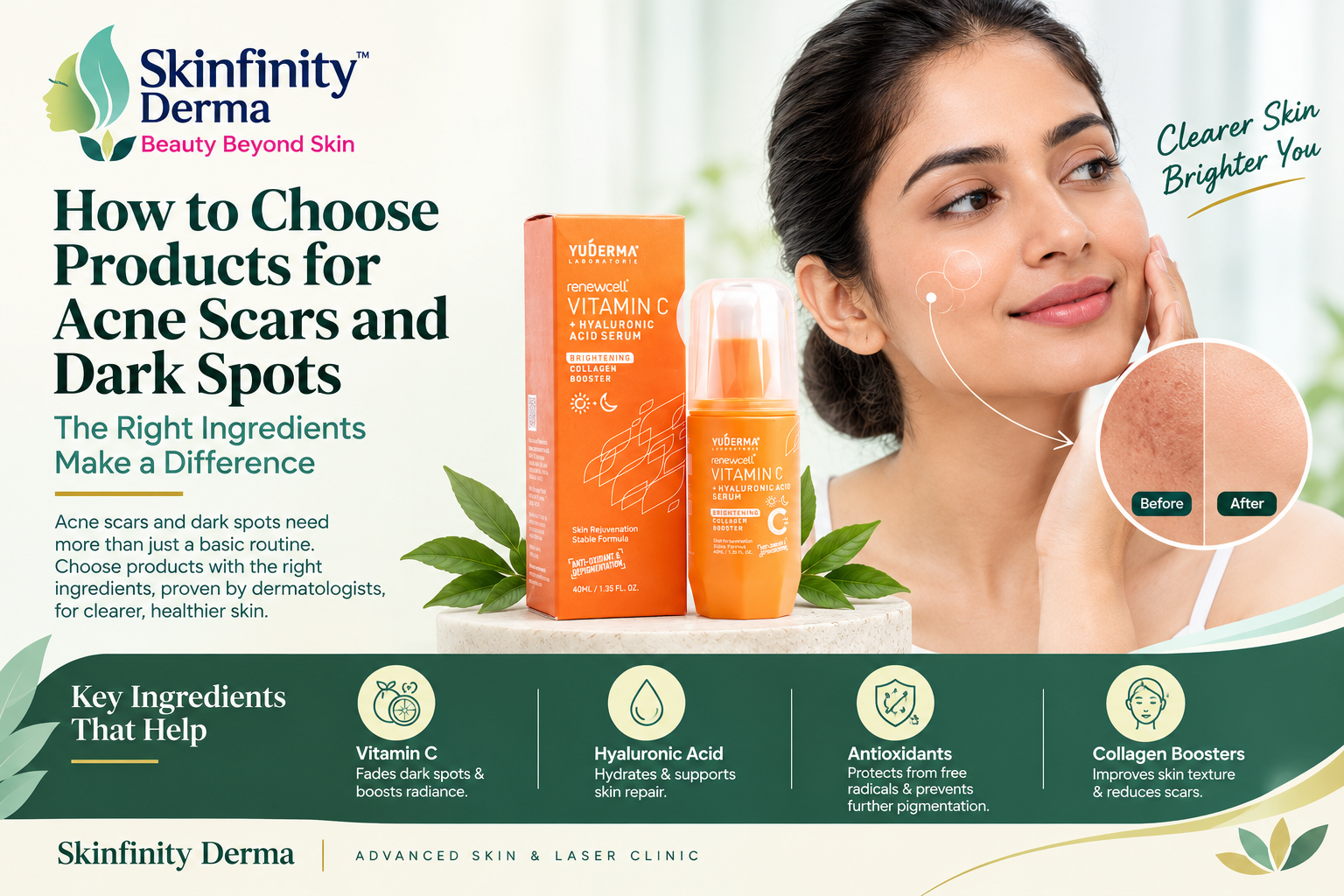
This guide explains how to select suitable ingredients, avoid common pitfalls, and build a manageable routine. It also explores where Yuderma Renewcell Vitamin-C + Hyaluronic Acid Serum may fit as part of a science-backed brightening regimen.
What Is the Difference Between Acne Scars and Dark Spots?
Dark spots after acne usually develop because inflammation triggers increased pigment production in melanocytes. This condition is clinically termed post-inflammatory hyperpigmentation (PIH).
These marks remain flat, meaning the surface of your skin usually feels completely smooth to the touch. Brown marks are particularly common in Indian skin tones, though deeper dermal pigment may occasionally appear grey or purple.
In contrast, true acne scars develop when inflammation damages and permanently alters the collagen matrix beneath the skin. They manifest as depressions (atrophic scars such as ice-pick, boxcar, or rolling scars) or raised tissue (hypertrophic or keloidal scars).
| Factor | Dark Spots & Acne Marks | Acne Scars |
|---|---|---|
| Appearance | Flat patches of discolouration (brown, red, or purple) | Indented, pitted, or raised skin contours |
| Main Change | Skin colour (excess melanin or vascular dilation) | Skin structure (collagen destruction or excess) |
| Texture | Smooth to the touch | Uneven, textured depressions or bumps |
| Natural Improvement | May fade gradually over months with sunscreen | Deep scars usually persist indefinitely without clinical procedures |
| Role of Skincare | Highly responsive to topical brighteners & SPF | Limited topical benefit for established deep depressions |
| Further Treatment | Medical skincare, azelaic acid, vitamin C, chemical peels | Scar-specific procedures (microneedling, subcision, laser resurfacing) |
Red or pink post-acne marks often reflect persistent micro-vascular changes (post-inflammatory erythema, or PIE) rather than excess melanin. They respond best to soothing, barrier-supportive ingredients, whereas brown marks require melanin-inhibiting actives.
How to Choose Products for Acne Scars and Dark Spots
The best products for dark spots should suit your skin tolerance and directly target the biological trigger. A stronger formula is not automatically better. Follow these six dermatologist guidelines:
- 1. Identify Whether the Concern Is Colour or Texture
Examine your skin in indirect natural daylight. A flat brown patch indicates pigmentation, whereas a visible depression or shadow indicates true scarring. If in doubt, consult a dermatologist, as many patients have both concerns simultaneously.
- 2. Control New Breakouts First
Repeated inflammatory acne creates new marks before older ones have time to fade. A pigmentation routine must always work alongside active acne management. Painful or cystic breakouts may require prescription treatments rather than cosmetic brighteners alone.
- 3. Choose One Main Treatment Ingredient at a Time
Begin with a single hero active matched to your primary concern. Azelaic acid is ideal when managing active pimples and residual marks together. Vitamin C is superb for overall tone and antioxidant defense.
- 4. Review Your Existing Routine
Check your current face wash and toner before adding new products. If your cleanser already contains salicylic or glycolic acid, adding a potent acid serum and retinoid simultaneously can trigger barrier irritation, worsening pigmentation.
- 5. Read the Complete Label
Pay close attention to overall vehicle formulation, pH, and soothing co-actives. Products labelled as "acne scar treatments" frequently target only discolouration. Verify whether claimed clinical benefits apply to pigment or actual scar depth.
- 6. Set Realistic Expectations
Topical skincare can noticeably brighten pigmentation over 8 to 16 weeks of diligent use. Deep ice-pick or tethered scars require clinic-based modalities.
Best Ingredients for Dark Spots and Post-Acne Marks
Dermatologists look for clinical actives with proven mechanisms for disrupting melanin synthesis and accelerating cellular renewal:
1. Azelaic Acid
Selectively targets abnormal melanocytes without bleaching surrounding healthy skin. Its dual anti-inflammatory and antibacterial properties make it the gold standard when acne and dark spots co-exist.
2. Vitamin C (L-Ascorbic Acid & Derivatives)
A potent antioxidant that inhibits the tyrosinase enzyme responsible for melanin production. It shields against environmental free radicals and promotes collagen synthesis for radiant, even-toned skin.
3. Niacinamide (Vitamin B3)
Blocks the transfer of melanin packets (melanosomes) from melanocytes to surface skin cells. It fortifies the epidermal lipid barrier and reduces sebum, making it exceptionally gentle and well-tolerated.
4. Retinoids (Retinol, Retinal, Adapalene)
Accelerate epidermal turnover, dispersing deposited pigment and preventing pore clogging. With sustained use, prescription retinoids can also stimulate dermal collagen remodeling.
5. Glycolic Acid (AHA)
Gently exfoliates the stratum corneum, helping shed superficial pigmented keratinocytes. Must be used judiciously in deeper skin tones to avoid irritation-induced rebound pigmentation.
6. Kojic Acid & Arbutin
Naturally derived tyrosinase inhibitors that help fade stubborn brown post-acne patches when formulated into stable, skin-friendly serums.
7. Hyaluronic Acid
Draws and binds up to 1,000 times its weight in water into the epidermis. While it does not lighten pigment directly, it maintains the cellular hydration needed for optimal healing and barrier recovery.
8. Hydroquinone
The most potent clinical depigmenting agent available, prescribed under strict medical supervision for defined cycles to address recalcitrant melasma and PIH.
Why Sunscreen Is Essential for Dark Spots
The Non-Negotiable Rule: No brightening serum can succeed without strict daily sun protection. Ultraviolet (UVA and UVB) radiation triggers melanocytes to produce defensive melanin within minutes of exposure.
Even brief unprotected exposure can re-darken fading acne marks, undoing months of consistent treatment. Use a broad-spectrum sunscreen with SPF 50+ and PA++++ every morning, rain or shine.
How to Build a Skincare Routine for Acne Marks and Dark Spots
A streamlined, purposeful regimen is easier to maintain and prevents barrier damage:
☀️ Morning Routine (Protect & Brighten)
- Step 1: Gentle Cleanser: Wash with a mild, sulfate-free cleanser that clears residue without stripping natural moisture.
- Step 2: Treatment Serum (Vitamin C): Apply 3–4 drops of a stabilized Vitamin C + Hyaluronic Acid serum onto clean, slightly damp skin.
- Step 3: Lightweight Moisturiser: Lock in hydration with a non-comedogenic, barrier-supportive moisturiser.
- Step 4: Broad-Spectrum Sunscreen: Apply at least two finger-lengths of SPF 50+ before sun exposure.
🌙 Evening Routine (Repair & Renew)
- Step 1: Gentle Removal: Use micellar water or a cleansing balm if wearing waterproof sunscreen or makeup.
- Step 2: Cleanser: Wash with lukewarm water and gently pat dry with a soft towel (avoid rubbing).
- Step 3: Evening Active Treatment: Apply your recommended active (e.g., Azelaic Acid, Retinoid, or Niacinamide) according to prescribed frequency.
- Step 4: Barrier Moisturiser: Apply a soothing ceramide cream to nourish the skin barrier while you sleep.
Yuderma Renewcell Vitamin-C + Hyaluronic Acid Serum at Derma Yoga
When searching for a dermatologist-trusted vitamin C formulation, Yuderma Renewcell Vitamin-C + Hyaluronic Acid Serum offers a balanced, stable solution:
- Dual Action Synergy: Combines stabilized Vitamin C for depigmentation and radiance with multi-molecular Hyaluronic Acid for deep epidermal hydration.
- Collagen Boosting: Supports natural collagen synthesis, helping refine skin texture around superficial post-acne imperfections.
- Gentle Daily Fit: Fits effortlessly into your morning routine immediately after cleansing and before moisturiser.
How to Choose Products Based on Your Skin Type
Oily or Acne-Prone Skin
Choose water-based, non-comedogenic serums. Azelaic acid and lightweight Vitamin C derivatives address dark marks without clogging pores. Never over-wash in an attempt to strip oil, as irritation triggers rebound sebum and deeper PIH.
Dry Skin
Prioritize barrier comfort first. Pair your active brightening treatment with ceramide-rich hydrators and Hyaluronic Acid. Introduce exfoliating actives slowly (1–2 times weekly) to avoid flaking.
Combination Skin
Use a gentle gel-cream cleanser. You can apply targeted brightening serums across the face while moisturizing more generously on cheeks and lightly across the oily T-zone.
Sensitive Skin
Start with a minimalist routine and introduce only one new product at a time. Opt for fragrance-free formulas and conduct a 24-hour patch test before full-face application.
Common Mistakes When Treating Acne Marks and Dark Spots
- ❌ Confusing marks with scars: Expecting topical brightening serums to fill deep, pitted textural indentations.
- ❌ Skipping sunscreen: Thinking indoor lighting or cloudy weather means SPF is optional.
- ❌ Over-exfoliating: Stacking multiple chemical peels and scrubs, which provokes secondary post-inflammatory hyperpigmentation.
- ❌ Picking or squeezing active pimples: Mechanical trauma drastically increases tissue damage and lasting melanin deposition.
- ❌ Changing products too quickly: Expecting overnight results; clinical cellular renewal requires at least 4 to 12 weeks.
- ❌ Chasing maximum percentages: Choosing a 20% acid that burns your skin barrier instead of a well-formulated, tolerable 10% active.
- ❌ Ignoring ongoing breakouts: Treating old spots while new pimples continue to form fresh pigmentation.
- ❌ Using unverified lightening creams: Applying unlabelled steroid or bleaching creams that can permanently thin or discolour the skin.
How Long Do Acne Marks and Dark Spots Take to Fade?
Melanin clearance takes place in phases synchronized with your epidermal cell cycle:
- Weeks 4 to 8: Early reduction in redness and initial softening of superficial brown spots with consistent active use.
- Months 3 to 6: Marked improvement in skin tone uniformity and significant fading of epidermal post-inflammatory marks.
- 6 to 12 Months: Deep dermal pigmentation gradually metabolizes. Daily sun protection prevents resurgence during this phase.
Dermatologist Tip: Take monthly photographs under identical indirect lighting to track objective progress, as daily mirror checks make gradual lightening difficult to notice.
When Should You Consult a Dermatologist?
You should schedule a professional clinical evaluation if:
- Acne lesions are cystic, painful, or visibly scarring the skin.
- Dark spots continue darkening or spreading despite daily sunscreen and gentle skincare.
- Skin experiences persistent redness, stinging, or peeling from everyday products.
- Textural pits, ice-pick depressions, or raised keloidal scars are visible.
- You need an accurate diagnosis distinguishing acne PIH from melasma or lichen planus pigmentosus.
Conclusion
Selecting the best products for acne scars and dark spots begins with distinguishing flat pigment from textural scarring. Flat post-acne marks respond remarkably well to targeted clinical skincare, stabilized Vitamin C, and relentless sun protection, while deep scars benefit most from dermatologist-led clinical procedures.
Introduce active treatments gradually, respect your skin barrier, and explore Yuderma Renewcell Vitamin-C + Hyaluronic Acid Serum at Derma Yoga as part of your dermatologist-curated skincare journey.